How does temperature affect filter press filtration speed is a practical question for operators, process engineers, and plant managers. A few degrees can change slurry viscosity, cake formation, and filtrate flow. Warm slurry often moves more easily through the filter cake. However, higher temperature does not guarantee faster filtration.
The details matter. In a working filter press, temperature interacts with solids concentration, chamber pressure, cloth permeability, and cake compressibility. A thick mineral slurry may respond differently from a food, chemical, or wastewater suspension. Small changes can be visible: filtrate may clear sooner, the pump may reach pressure earlier, or the cake may release unevenly.
Not always faster.
From operating experience, temperature should be measured at the press inlet, not assumed from the storage tank. Heat loss in pipes can be significant. Recording cycle time, filtrate volume, pressure, and cake moisture creates stronger evidence than relying on appearance alone. Industry filtration principles support this approach, but every slurry still requires verification through controlled trials.
A simple rule can mislead. Excessive heat may damage filter cloths, alter product quality, increase energy use, or create safety concerns. Temperature can also change particle behavior and produce a more compressible cake. That effect may reduce the expected gain.
This article examines the mechanisms behind temperature-related filtration changes. It also considers practical testing, equipment limits, and measurement errors. The goal is not to promise one universal temperature setting. It is to help readers make defensible operating decisions using process data, manufacturer guidance, and careful observation.
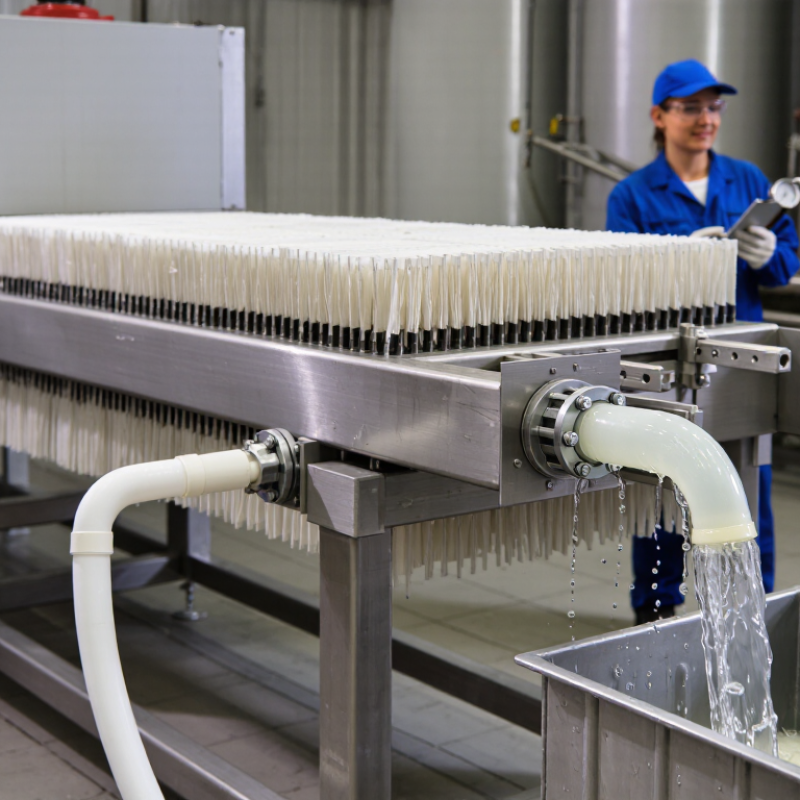
Define Filter-Press Speed with Darcy’s Law and Cake Resistance
How Does Temperature Affect Filter Press Filtration Speed?
Filter-press speed is best defined through Darcy’s law, not by cycle time alone.
The filtration flux can be written as J = dV/(A dt).
It depends on pressure, liquid viscosity, filter area, and resistance. In practical form,
J = ΔP/μ(Rm + αCV/A).
Here, Rm represents medium resistance, while α describes cake resistance. As temperature rises, viscosity usually falls. The liquid can then pass through the cake more easily.
The cake still controls the process.
A fine, compressible cake may become denser under pressure, increasing α and slowing filtration. Temperature can also change particle settling, dissolved solids, and liquid properties. Therefore, a warmer feed does not always create a faster cycle. The effect may be noticeable when pumping a thick suspension through a cake that feels firm and uneven. It may be small when the cake already dominates total resistance.
A reliable test records temperature, pressure, filtrate volume, and time together.
Compare the calculated flux at each temperature, rather than comparing only final cycle times. Keep the feed concentration and cloth condition consistent. This matters.
The simple equation is useful, but imperfect.
Cake resistance can change during one cycle. Cloth blinding may also hide the viscosity benefit. In field trials, a modest temperature increase often improves early filtration, while later flow declines as the cake thickens. Avoid heating without checking cake quality, material stability, and equipment limits. Faster flow is not automatically better filtration.
Compare Water Viscosity: 1.002, 0.653, and 0.467 mPa·s at 20, 40, and 60°C
How Does Temperature Affect Filter Press Filtration Speed?
Water viscosity strongly controls liquid movement through a filter cake.
The IAPWS Release on the Viscosity of Ordinary Water Substance reports dynamic viscosities near
1.002 mPa·s at 20°C,
0.653 mPa·s at 40°C, and
0.467 mPa·s at 60°C.
These values show a sharp decline as temperature rises.
Under identical pressure, cake thickness, and solids concentration, Darcy’s law predicts faster filtration at lower viscosity.
Moving from 20°C to 40°C could increase the ideal liquid-flow rate by approximately
53%.
At 60°C, the theoretical increase reaches about
115%
compared with 20°C.
In practical filter press operation, the improvement may be smaller. Cake compressibility, cloth blinding, feed concentration, and pump capacity also restrict flow.
Field observations often reveal this gap.
A warm feed may drain quickly through the first chambers, then slow as the cake becomes denser.
That detail matters. Temperature does not remove resistance; it mainly reduces liquid friction.
IAPWS data provide reliable water-property values, but industrial slurries require direct testing.
Suspended minerals, dissolved salts, and polymers can change viscosity differently from pure water.
Operators should record feed temperature, pressure, filtrate volume, and cycle time during trials.
One assumption can fail:
heating the slurry may improve speed, but it may also alter particle flocculation or cake structure.
Explain Why Lower Viscosity Can Increase Filtration Rate
Temperature changes filter press performance mainly by changing liquid viscosity. Lower viscosity lets filtrate pass through the cake more easily. Darcy’s law links filtration rate directly to pressure and inversely to viscosity.
NIST Standard Reference Database 69 lists water viscosity near 1.00 mPa·s at 20°C, falling to about 0.55 mPa·s at 50°C. That reduction can nearly double flow potential under similar conditions. In a working press, this may mean faster chamber filling and shorter cycles. The effect is visible at the outlet: filtrate changes from a slow drip to a steadier stream. Small gains matter.
However, sludge is rarely as simple as water. Its viscosity depends on solids concentration, particle shape, and polymer conditioning. The U.S. EPA fact sheet 832-F-00-057 identifies feed solids, polymer dosage, pressure, and operating speed as major dewatering variables. Heating may lower viscosity, but excessive heat can weaken floc structure or increase odor and energy demand.
A practical trial should compare equal feed volumes at controlled temperatures. Record filtrate volume every five minutes, cake thickness, and final moisture. Do not trust flow speed alone. A faster cycle can produce a wetter cake. I have also seen temperature improve flow while reducing cake clarity, which is an uncomfortable trade-off. The best setting is not always the warmest one.
Evaluate Cake Compressibility Under Typical 0.6–1.6 MPa Pressures
Temperature can change filter press speed before the pump pressure changes. Warmer slurry usually flows more easily because liquid viscosity falls. This can shorten the early filling stage. However, temperature also affects particle structure, solids hydration, and cake resistance. Faster flow is not guaranteed.
Evaluate cake compressibility between 0.6 and 1.6 MPa. Use the same slurry, cloth, chamber depth, and filtration area for every test. Record filtrate volume and time at each pressure step. A compressible cake may pass fluid quickly at 0.6 MPa, then become denser near 1.6 MPa. Its pores narrow under pressure. Filtration speed can decline despite higher driving force.
Keep temperature stable within a narrow range. Even a ten-degree change may alter viscosity enough to confuse the results. Measure slurry temperature at the feed inlet, not only in the tank. Check cake thickness after opening the press. Look for a glossy, tightly packed surface. That detail often signals strong compression.
Do not trust one pressure reading. Repeat each condition at least three times. Real slurries are rarely uniform. Some tests may disagree. That is useful evidence, not a failure. Plot filtration resistance against pressure, then compare warm and cool runs. A mild temperature increase may improve throughput, while excessive heat can change solids behavior or damage the cloth. Safety checks remain essential when operating near 1.6 MPa.
Set Temperature Limits for Product Quality, Safety, and Filter-Media Life
How Does Temperature Affect Filter Press Filtration Speed?
Set Temperature Limits for Product Quality, Safety, and Filter-Media Life
Temperature can increase filter press speed, but faster is not always better. According to the IAPWS water-property formulation, water viscosity falls from about 1.00 mPa·s at 20°C to 0.65 mPa·s at 40°C. Lower viscosity usually improves flow through the cake and cloth. However, slurry behavior may change unexpectedly.
A practical operating window should protect product quality first. For heat-sensitive materials, excessive temperature can accelerate oxidation, evaporation, crystallization, or microbial growth during delays. The FDA Process Validation guidance supports controlling critical process parameters, including temperature, through documented studies. Record filtrate clarity, cake moisture, cycle time, and product assay at several temperature points.
Filter-media life also needs a defined limit. The media supplier’s temperature rating is only a starting point. Chemical exposure, pressure, cleaning frequency, and thermal cycling can reduce actual service life. PDA Technical Report No. 26 emphasizes compatibility and integrity testing for critical filtration applications. In a pilot trial, test 20°C, 30°C, and the proposed upper limit. Inspect cloth shrinkage, seam damage, and pore blinding after repeated cycles. Do not assume a 10°C increase is harmless. One plant may gain minutes, then lose weeks of media life. Safety matters too: heated slurries can create burns, vapor pressure, or unstable reactions. Set alarms below the validated limit, and review the limit after every formulation change.
How Does Temperature Affect Filter Press Filtration Speed? - Set Temperature Limits for Product Quality, Safety, and Filter-Media Life
Representative operating data for an aqueous mineral suspension processed at constant pressure. Actual results depend on slurry solids, particle size, cake permeability, filter area, cloth type, and pressure.
| Slurry Temperature (°C) |
Approx. Liquid Viscosity (mPa·s) |
Relative Filtration Rate
(20°C = 100) |
Typical Filtrate Flow
(L/m²·min) |
Expected Cake Moisture
(% w/w) |
Product-Quality Considerations |
Filter-Media and Safety Considerations |
Recommended Status |
| 5 |
1.52 |
66 |
4.0 |
31–34 |
Slow drainage and higher residual liquid may reduce washing efficiency. |
Low thermal stress; check for crystallization or slurry thickening at low temperature. |
Low-speed operation |
| 10 |
1.31 |
77 |
4.7 |
29–32 |
Improved flow compared with 5°C, with limited thermal impact on most aqueous products. |
Generally gentle on cloth and gaskets when compatible materials are used. |
Acceptable |
| 20 |
1.00 |
100 |
6.1 |
27–30 |
Balanced filtration rate, product stability, and cake handling. |
Suitable reference point for evaluating cloth wear and cycle time. |
Preferred baseline |
| 30 |
0.80 |
125 |
7.6 |
26–29 |
Often provides faster cycles without substantial quality loss in temperature-stable products. |
Low-to-moderate thermal load; inspect seals if cycling frequently. |
Preferred operating range |
| 40 |
0.65 |
154 |
9.4 |
25–28 |
Low viscosity supports rapid drainage, but heat-sensitive ingredients require verification. |
Usually manageable with compatible media; confirm gasket and cloth temperature ratings. |
Upper preferred limit |
| 50 |
0.55 |
182 |
11.1 |
24–27 |
Potentially faster cycles, but oxidation, evaporation, solubility, or flavor changes may occur. |
Accelerated aging of some polymeric media and elastomers; monitor pressure and leakage. |
Controlled use only |
| 60 |
0.47 |
213 |
13.0 |
23–26 |
Risk of thermal degradation, concentration changes, or altered particle behavior increases. |
Verify the lowest-rated component; hot surfaces and pressurized hot slurry increase burn risk. |
Approvals required |
| 70 |
0.40 |
250 |
15.3 |
22–25 |
High risk of product-property changes; laboratory quality testing is essential before routine use. |
Potentially shortened media life, seal damage, vapor formation, and elevated operator-safety risk. |
Do not use without validation |
Reference basis: Values represent a typical aqueous suspension with approximately 0.5% solids, constant filtration pressure near 1.5 bar, and a clean synthetic filter cloth. Relative filtration rate is an engineering comparison, not a guaranteed production rate. Set the final temperature limit using product stability data, equipment ratings, pressure-relief requirements, and the rating of the lowest-temperature component.
Conclusion
How does temperature affect filter press filtration speed? The answer is closely linked to liquid viscosity and cake resistance. Under Darcy’s law, filtration rate increases when viscosity decreases, provided that pressure, filter area, and cake structure remain constant. For water, viscosity falls from approximately 1.002 mPa·s at 20°C to 0.653 mPa·s at 40°C and 0.467 mPa·s at 60°C. This reduction allows liquid to pass through the filter cake more easily, potentially shortening cycle time and increasing throughput.
However, temperature does not eliminate resistance caused by the cake. At typical pressures of 0.6–1.6 MPa, compressible cakes may become denser as pressure rises, reducing permeability and limiting the expected speed improvement. Higher temperatures can also affect product quality, worker safety, and filter-media durability. Therefore, the best operating temperature should balance lower viscosity with thermal stability, safe handling, and acceptable media life rather than simply maximizing heat.

 Jovios Equipment